 RJ Hamster
RJ Hamster
RJ Hamster
RJ Hamster
RJ Hamster
RJ Hamster
RJ Hamster
April 30, 2026
5,400% Growth. Final Window Before 4/30.
The strategy that built Warren Buffett’s Berkshire Hathaway was simple: acquire great businesses and compound value.
Now, RAD Intel is applying that model to AI. Its platform predicts marketing performance before spend, already driving Fortune 1000 adoption and seven-figure contracts.
The company has delivered 2× sales growth in 2025 and 5,400%+ valuation growth over five years. Backed by multiple institutional funds. Selected by the Adobe Design Fund. Nasdaq ticker reserved: RADI.
Shares are currently $0.91.
The round is ~90% allocated.
This is a paid advertisement for RAD Intel made pursuant to Regulation A+ offering and involves risk, including the possible loss of principal. The valuation is set by the Company and there is currently no public market for the Company’s Common Stock. Nasdaq ticker “$RADI” has been reserved by RAD Intel and any potential listing is subject to future regulatory approval and market conditions. Brand references reflect factual platform use, not endorsement. Investor references reflect factual individual or institutional participation and do not imply endorsement or sponsorship by the referenced companies. Some media placements are earned organically, while others may be paid sponsorships or promotional placements. Please read the offering circular and related risks at invest.RADIntel.ai.
Update your email preferences or unsubscribe here
© 2026 GEOPOLITIKS
17 Littoral Frédéric Mistral
Toulon, France 83000, France Terms of Service
RJ Hamster


Follow @FlipboardSee More in The Daily EditionDownload App


Stay informed and inspired!
Download Flipboard to get the latest news and stories on the topics you care about.


How bald eagle nest cams hook online communities NPR · Ava Berger Like soap operas, 75 feet up.


Was this sent to you by a friend? For more like it, subscribe here.BLOG · CAREERS · ADVERTISEUpdate your email preferences or unsubscribe here.View our privacy policy here.©2026 Flipboard, Inc. Made with love at 555 Bryant St #352 Palo Alto, CA 94301
RJ Hamster


“I won’t see you next time.”
That’s how Jerome Powell concluded the press conference after his final Federal Open Market Committee meeting as Federal Reserve Chair on Wednesday.
It sounded like a clean goodbye.
But like a lot of things around the Fed these days, the reality is a little more complicated.
Powell’s final meeting as Fed Chair ended with no rate cut, no clear consensus and no easy answers.
Right now, the Fed is more divided than it has been in decades. Inflation is still sticky. Energy prices are muddying the picture. And even though rate cuts may be coming, nobody seems to agree on how soon they should begin.
As for Powell, his term as Fed Chair ends on May 15. Kevin Warsh is moving closer to taking over the gavel after the Justice Department dropped its criminal investigation into Powell and the Senate Banking Committee advanced Warsh’s nomination. A vote is expected soon.
But Powell has also said he plans to remain on the Fed Board after his Chair term ends. So, Warsh may take over as Chair while Powell remains in the room.
That is unusual. Most modern Fed Chairs have left once they handed over the gavel. I’ll have more to say about this changing of the guard next week, but in today’s Market 360, I want to focus on what happened at the latest meeting, what the latest inflation data tells us about future rate cuts – and why the bigger opportunity may have nothing to do with the Fed at all.
Recommended Link
Luke Lango was ranked America’s #1 stock picker in 2020. He was mentored by two hedge fund billionaires from the Soros network and trained at Caltech. His readers have had the chance to see gains as high as AMD +8,500%… Nvidia +5,000%… Tesla +3,500%… Palantir +1,000%… and Apple +890%. Now he’s releasing his next big pick.
On Wednesday, the Fed held its benchmark interest rate steady at 3.5% to 3.75%. That marks the third-straight meeting where the central bank decided to sit tight.
Fed Governor Stephen Miran wanted to cut rates immediately. But three Fed hawks supported holding rates steady and did not want to telegraph future cuts. In plain English, one group wants to start easing now, while another group does not want Wall Street assuming rate cuts are guaranteed.
I understand why the Fed is hesitant. Cut too soon, and it risks feeding inflation. Wait too long, and it risks choking off growth. That is the box Powell has been in for months.
But I think what they’re missing is the fact that a lot of the inflation we are dealing with right now is energy-related, which was evident in this morning’s Personal Consumption Expenditures (PCE) reading.
Core PCE rose 0.3% in March, pushing the annual rate to 3.2% – its highest level since November 2023. Headline PCE rose 0.7% for the month and 3.5% over the past year, as oil prices pushed consumers’ costs higher.
The good news: These numbers matched expectations, so this was not an inflation shock.
The bad news: Inflation is still too hot for the Fed to declare victory.
Personally, I do think rate cuts are coming, because the reality is that the Fed cannot control energy prices. But if the conflict in the Middle East can wrap up soon, then energy prices should cool, and inflation could start looking better quickly.
And if inflation looks better, the new Fed regime will have more cover to cut.
What people need to understand is Kevin Warsh is not some unknown. He was at the Fed during the 2008 financial crisis, so he knows what it means to act when markets are under stress.
But he also has a different view of monetary policy than Powell. We’ll get into that more next week. For now, I would just say that a Warsh-led Fed is much more likely to act quickly on interest rates, especially if inflation cools and energy prices stop pressuring the data.
Lower rates make it cheaper for companies to borrow and expand. They also tend to push investors back toward stocks, especially growth stocks.
But I do not want you to make the mistake of thinking rate cuts solve everything.
There is still risk in the bond market. If bond vigilantes keep pushing long-term yields higher, investors can collect a nice yield but still watch their principal erode. That is a problem Treasury Secretary Scott Bessent will have to deal with.
So, the biggest fortunes aren’t made by waiting for the Fed to give the all-clear. They are made by getting positioned before the next great market reset becomes obvious to everyone else.
And right now, I believe that reset is happening in AI.
The first phase of the AI boom was about chatbots, graphics chips and data centers. It produced some incredible winners.
But the next phase could be much bigger. It will be the phase where you’ll hear about things like scientific AI breakthroughs, AI agents, national-security AI infrastructure, quantum computing, nuclear fusion, and more.
That is why I recently sat down for an urgent presentation about what I call the AI Reset.
When a reset that big happens, the old winners do not always remain winners.
And in my special presentation, I explain why some of today’s most popular AI stocks could be vulnerable… which new class of AI stocks I believe could benefit as this technology comes online… and the AI stocks I believe investors should buy – and avoid – before this reset hits.
Sincerely,

Louis Navellier
Editor, Market 360
 RJ Hamster

APRIL 30, 2026 | READ ONLINE
Quick question…
Would you spend 60 seconds to save yourself $29.97?
That’s what my “Simple Options Trading For Beginners” book costs on our website right now. But today, I’m giving it away — no charge, no strings.
Inside, you’ll discover a simple approach to options trading that doesn’t require you to sit in front of a screen all day… or risk your shirt on any single trade.
It’s the same book that sells for $29.97 on our website right now, but is yours on the house today.
All you have to do is click here and tell me where to send it.
Good Trading,
Bill Poulos
p.s. This won’t stay free forever — $29.97 is a fair price and I’ll be going back to it soon.
Grab your copy here before that happens.
More Reading from MarketBeat
Authored by Jeffrey Neal Johnson. First Published: 4/21/2026.

For more than two decades, a key regulation served as a barrier between the average retail investor and high-frequency day trading. That barrier was removed on April 14, 2026, when the Securities and Exchange Commission (SEC) approved the elimination of the Pattern Day Trader (PDT) rule. The PDT framework, born from the dot-com bust of the early 2000s, required novice traders to maintain $25,000 in account equity to protect them from the risks of hyperactive trading.
As of the SEC decision, that static capital requirement is gone and the PDT designation no longer exists. It has been replaced by a dynamic, technology-driven model in which brokerages must monitor an account’s Intraday Margin Level (IML)—a real-time calculation of its ability to cover intraday risk.
When the SpaceX IPO launches, most retail investors will be locked out. The banks, funds, and insiders get in early – while everyone else waits on the sidelines.
But one small infrastructure supplier – a critical piece Musk can’t scale the Colossus network without – is still trading well under institutional radar. A new briefing reveals the name and ticker at no cost.
Get the SpaceX infrastructure stock name and ticker here
While the $2,000 minimum to open a margin account remains in place, the high-cost gatekeeping effect of the $25,000 threshold has vanished. Brokerages will have 45 days to begin implementing the changes, with an 18-month phase-in period for full adoption. The shift fundamentally alters the market’s risk framework: the gatekeeper is now the sophistication of each broker’s algorithm rather than the size of an investor’s wallet.
The market reacted positively to the rule change, delivering a clear endorsement for the retail brokerage industry. The development is seen as a tailwind for companies that rely on user engagement and trading volume. Investor sentiment strengthened on the expectation that millions of smaller accounts will trade more frequently.
More trading activity can directly increase revenue opportunities. Even with zero-commission trades, brokerages earn through payment for order flow (PFOF), receiving compensation for routing trades to market makers. Higher volume also boosts potential income from margin lending as more investors borrow to leverage positions.
This regulatory change validates the technology-first, low-friction model of modern platforms and positions them to attract a new wave of active users, potentially lifting top-line growth in upcoming quarters.
The overhaul is more than a technical adjustment; it marks a structural accommodation to the gamification of finance—a trend that surged during the post-pandemic trading boom and brought millions of new participants to the market.
These users gravitated to platforms that mimic the engagement of video games and social media, with simple interfaces, celebratory animations for completed trades, and integrated social features that foster community and competition.
Eliminating the PDT rule can be seen as the regulated financial system adapting to this new reality. It lets traditional brokerages capture the speculative energy that helped fuel meme stocks and flow into alternative arenas like the cryptocurrency sector.
The change signals that regulators and firms recognize modern retail investors are attracted to gamified experiences. Lowering the barrier to entry doesn’t just invite more participants; it aligns the equities market more closely with their habits and expectations.
With broader access to intraday trading, speculative capital is likely to concentrate in sectors known for high volatility and easy-to-understand narratives. These areas may see increased trading activity and wider price swings:
The removal of the Pattern Day Trader rule ushers in a new era of market access, but it is a double-edged sword. Democratizing high-frequency trading raises the potential for amplified risk, and the statistical reality remains: the vast majority of active day traders do not profit over the long term.
With regulatory guardrails replaced by brokerage algorithms, discipline and a sound strategy matter more than ever. Investors should proactively review their brokerage’s new margin policies, because firms will implement IML rules differently.
Understanding how intraday margin is calculated is critical. This is also a moment to reassess personal risk tolerance—being able to trade more frequently does not mean one should. Success in this environment will likely depend on distinguishing disciplined, long-term investing from the allure of short-term, gamified speculation..
Update your email preferences or unsubscribe here
© 2026 The Markets Daily
345 N Reid Place #620
Sioux Falls, SD 57106, United StatesTerms of Service
RJ Hamster
If you are not able to see this mail, click here If you wish to unsubscribe from our newsletter, click here

Did you see that headline today???
Big tech darlings like NVDA, META dip to really attractive prices. You have seen this over and over and they keep rallying back up. It looks exactly like a sweet opportunity.
The setup seems ideal: strong trend… pullback… everything looks right…
But then, you hesitate.
And just like that, the stock soars leaving you behind!
I’m Wendy Kirkland and I built Kirkland Black Box to help you escape the horrible frustration of missing trades. Even with the war making it tougher to spot set ups and identify tradable trends, this helps me pull the trigger with confidence.
Watch this video and I’m sure you’ll be as excited as me!
Or, if you don’t want to mess around just hit “Show Me Details” and you can be on your way in a matter of minutes with a state-of-the-art automated trading tool for cheaper than a pepperoni pizza.
You should at least take a look so you have no regrets. But you need to hurry.
Best Wishes,
Wendy Kirkland
© 2026 TradeWins.com. All Rights Reserved. Privacy Policy | Disclaimer | Terms and Conditions | Contact Us
NOTICE: Auto-trading, or any broker or advisor-directed type of trading, is not supported or endorsed by Universal Financial Independence Inc. (“Universal”). The information provided by Universal in its various materials, including trading recommendations, newsletters and educational publications is not customized or personalized for any particular person or risk profile. Past results are not necessarily indicative of future results. Results presented can vary and may not be typical for all subscribers. There are substantial risks involved with investing in the stock and options market, including the risk of total loss. You should only trade or invest “risk capital” – funds you can afford to lose.
RJ Hamster
A message from i2i Marketing Group, LLC
Dear Reader,
From clean energy to semiconductors to defense – the future is made of metals.
And one group is assembling a portfolio to meet that moment – with early-stage holdings in uranium, titanium, vanadium, and more across resource-rich regions in North America.
It’s not a single-commodity.. It’s a broader play on scarcity, reshoring, and national security – wrapped into a drilling-ready package.
Why the setup stands out:
If diversification and timing matter, this play deserves a closer look.
Take a closer look before more investors catch on
Further Reading from MarketBeat.com
Author: Jeffrey Neal Johnson. Posted: 4/30/2026.

The transportation sector continues to weather a protracted freight recession, with persistent margin compression and volume headwinds challenging even the most established operators. Against this difficult backdrop, TFI International (NYSE: TFII)delivered first-quarter results that suggest a cyclical bottom may be forming for best-in-class logistics companies. TFI’s ability to pull operational levers and preserve profitability in a weak market signals a potential turning point, positioning it to capture upside as supply chains normalize and industrial activity rebounds.
The most compelling evidence of a market shift is in TFI International’s Less-Than-Truckload (LTL) segment, its largest division by revenue. The segment experienced a dramatic intra-quarter reversal that outpaced general market trends. After starting the year with a 10% year-over-year decline in shipment volumes in January — exacerbated by severe weather — momentum shifted sharply, with March volumes expanding by 8%.
When the SpaceX IPO launches, most retail investors will be locked out. The banks, funds, and insiders get in early – while everyone else waits on the sidelines.
But one small infrastructure supplier – a critical piece Musk can’t scale the Colossus network without – is still trading well under institutional radar. A new briefing reveals the name and ticker at no cost.Get the SpaceX infrastructure stock name and ticker here
Management confirmed on its April 27, 2026, earnings call that this positive trend has continued into the second quarter, suggesting the demand inflection is not a temporary rebound but the start of a sustainable recovery.
This volume inflection is the direct catalyst behind management’s aggressive forward guidance. TFI expects a sequential improvement of 400–500 basis points in its consolidated operating ratio (OR) for Q2, with the LTL segment forecast to lead the charge with a 600–700 basis-point sequential OR improvement.
As volumes return, TFI’s leaner cost structure and improved network density should allow a greater share of revenue to flow through to operating income. This improvement is further supported by the mid-March implementation of a general rate increase (GRI), which will provide a pricing tailwind through the second quarter. While TFI’s service levels are still being refined relative to industry leaders, the volume recovery gives the company the operational leverage to be more selective with freight and begin closing the pricing gap with peers.
While the LTL segment shows signs of recovery, the Truckload division demonstrates the power of disciplined fleet management and strategic market focus. TFI grew its revenue per truck per week, excluding fuel surcharges, by 8.6% in the first quarter while reducing its total truck count by 7.1%.
Running fewer assets while generating higher revenue per unit is a clear sign of a management team prioritizing productivity and profitability over sheer market share. It reflects a cultural shift, particularly within the legacy Daseke operations, from being good truckers to being good stewards of capital who focus on return on invested capital.
This operational discipline is translating into pricing power, especially in TFI’s industrial-focused end markets. Management noted recent U.S. flatbed contract renewals are coming in at high-single to low-double-digit increases. That pricing strength is partly driven by tightening capacity across the U.S. and Canada, as regulatory actions have removed unsafe and non-compliant operators from the market. By focusing on industrial freight — for example, data center construction logistics, which grew from $8 million to $21 million year over year — TFI insulates itself from the volatility of retail-centric freight and aligns with a potential North American industrial resurgence.
Despite the strong quarterly performance and optimistic Q2 outlook, management has refrained from issuing full-year 2026 guidance. That caution is primarily tied to geopolitical and macroeconomic uncertainty, specifically the mandatory joint review of the USMCA (CUSMA) trade agreement scheduled for July 2026. The review creates a “certainty cliff” for cross-border freight, a highly profitable area for TFI. While this presents a near-term risk that tempers full-year forecasts, it also creates a coiled-spring opportunity: a smooth, favorable resolution would likely trigger a meaningful relief rally and force analysts to revise full-year estimates upward.
TFI’s capital allocation choices underscore internal confidence. In the earnings release, the board approved a 4% increase in the quarterly dividend to 47 cents per share. That decision came even as Q1 free cash flow fell year over year to $123.7 million — a dip management attributed to a temporary working capital distortion driven by fuel payment timing. Raising the dividend in that context signals a strong belief in the sustainability of future cash flows and a commitment to returning capital through the cycle.
The first-quarter earnings beat and strong guidance were major catalysts, sending shares to a new 52-week high on heavy volume. The stock’s performance reflects the emerging narrative, with a year-to-date return of over 35%.
Sell-side analysts moved quickly to validate the thesis. Following the report, Bank of America (NYSE: BAC) upgraded the stock from Neutral to Buy and raised its price target to a street-high $161. The current consensus rating is Moderate Buy, reflecting a mix of bullish outlooks and some analysts waiting for further confirmation of the recovery.
Investors seeking exposure to the freight cycle may find TFI’s demonstrated operational control a compelling reason to add the stock to their watchlist. While macro risks tied to trade policy and fuel costs persist, TFI’s ability to drive a margin inflection before a full market recovery sets it apart. Those with higher risk tolerance may view the current momentum as the start of a sustained cyclical upswing; more cautious investors may prefer to wait for consolidation before establishing a position.
This email message is a paid advertisement for i2i Marketing Group, LLC, a third-party advertiser of MarketBeat. Why did I get this email content?.
We are not securities dealers or brokers, investment advisers or financial advisers, and you should not rely on the information herein as investment advice. Any investment should be made only after consulting a professional investment advisor and only after reviewing the financial statements and other pertinent corporate information. Further, readers are advised to read and carefully consider the Risk Factors identified and discussed in the profiled company’s SEC and/or other government filings. Investing in securities, particularly microcap securities, is speculative and carries a high degree of risk.
If you need assistance with your account, feel free to email our South Dakota based support team at contact@marketbeat.com.
If you would no longer like to receive promotional emails from MarketBeat advertisers, you can unsubscribe or manage your mailing preferences here.
Copyright 2006-2026 MarketBeat Media, LLC. All rights protected.
345 N Reid Place #620, Sioux Falls, S.D. 57103-7078. United States..
RJ Hamster

AN OXFORD CLUB PUBLICATION
Loyal reader since August 2025

Dear Reader,
Elon’s filing for the SpaceX IPO just hit the mainstream news…
And everyone is wondering how I called it… almost to the exact day being reported.
Well…
I met Elon Musk face to face.
At a private gathering of the world’s financial elite, I was one of just two people selected to speak with him personally.
That conversation – combined with three years studying patterns at CIA headquarters – is why my SpaceX prediction was dead on accurate.
And while the mainstream media was playing catch-up…
I had already helped nearly 25,000 Main Street Americans discover the “backdoor” way to stake a claim pre-IPO.
Now the stakes are even higher.
The filing just happened.
21 banks – including JPMorgan, Goldman Sachs, and Morgan Stanley – are preparing to underwrite what they’re calling “Project Apex.”
The framework for the biggest IPO in Wall Street history.
Everyone is now looking at June.
So here’s what that means for you and your money…
You just got a gift.
A few more weeks to position yourself before the biggest gains are gobbled up by Wall Street insiders.
Once the roadshow kicks off… once the media frenzy begins… once millions of investors scramble to get in…
The window slams shut.
But right now – today – you still have time.
I’m giving away my top pre-IPO SpaceX pick completely free.
No credit card. No email required.
But I wouldn’t wait.
June is coming fast.
Click here to get my FREE SpaceX pre-IPO recommendation now.
On the hunt,
Jonathan
P.S. I’ve already helped nearly 25,000 everyday investors get positioned before this historic IPO. Now it’s your turn. But the window is closing fast. Get my free recommendation here… before it’s too late.
You are receiving this email because you subscribed to Liberty Through Wealth.
Liberty Through Wealth is published by The Oxford Club.
To stop receiving special invitations and offers from Liberty Through Wealth, please click here.
Please note: This will not impact the fulfillment of your subscription in any way.
Questions? Check out our FAQs. Trying to reach us? Contact us here.
Please do not reply to this email as it goes to an unmonitored inbox.
Privacy Policy | Whitelist Liberty Through Wealth
© 2026 The Oxford Club, LLC All Rights Reserved
The Oxford Club | 105 West Monument Street | Baltimore, MD 21201
North America: 866.237.0436 | International: 443.353.4540
Oxfordclub.com
Nothing published by The Oxford Club should be considered personalized investment advice. Although our employees may answer your general customer service questions, they are not licensed under securities laws to address your particular investment situation. No communication by our employees to you should be deemed personalized investment advice. We allow the editors of our publications to recommend securities that they own themselves. However, our policy prohibits editors from exiting a personal trade while the recommendation to subscribers is open. In no circumstance may an editor sell a security before subscribers have a fair opportunity to exit. The length of time an editor must wait after subscribers have been advised to exit a play depends on the type of publication. All other employees and agents must wait 24 hours after publication before trading on a recommendation.
Any investments recommended by The Oxford Club should be made only after consulting with your investment advisor and only after reviewing the prospectus or financial statements of the company.
Protected by copyright laws of the United States and international treaties. The information found on this website may only be used pursuant to the membership or subscription agreement and any reproduction, copying or redistribution (electronic or otherwise, including on the world wide web), in whole or in part, is strictly prohibited without the express written permission of The Oxford Club, LLC, 105 West Monument Street, Baltimore, MD 21201.
REF: 000142349377
RJ Hamster


Thursday, April 30

Welcome to The Pregame Lineup, a weekday newsletter that gets you up to speed on everything you need to know for today’s games, while catching you up on fun and interesting stories you might have missed. Today’s edition is brought to you by David Adler.
If you’re the first hitter to do something since Barry Bonds, you’re probably in a pretty good spot.
Well, Nick Kurtz is drawing walks like Barry Bonds.
To be more specific: The A’s slugger has walked in 18 consecutive games entering play today. That’s the longest walk streak since Bonds at the peak of his powers in 2002-03.
And it’s not just that. Kurtz’s walk streak is the fourth-longest in MLB’s Modern Era — that’s since 1900. The list is a pretty cool one: Kurtz, Bonds, Ted Williams … and one surprise name at the very top.
Most consecutive games with a walk, Modern Era
Let’s take a second to talk about the elephant in the room: Roy Cullenbine??? How is he No. 1 and not Bonds or the Splendid Splinter?
Well, Cullenbine was actually something of a walk machine back in the ’40s. He was a two-time All-Star, he led the American League with 113 walks in 1945 (when he won a World Series with the Tigers), and he had a career-high 137 in 1947. That’s the year he had his streak, walking in every game for Detroit from July 2 to July 22. And now he has an MLB record to show for it.
But anyway, back to Kurtz.
The 23-year-old Rookie of the Year winner has already blown past the A’s franchise record, which was held by the great Rickey Henderson, who walked in 15 straight games during the 1993 season.
And even Bonds never had a walk streak as long as Kurtz’s within a single season. In 2002, Bonds walked in the final 18 games of the season before continuing his streak at the start of 2003. And even in his record-setting 232-walk 2004 season, Bonds’ longest walk streak was 16 consecutive games.
Kurtz, unsurprisingly, leads the Majors with 32 walks this season (entering play today), and as he’s gotten hot, the A’s have taken over first place in the AL West.
The A’s game today just started as of the sending of this newsletter, so tune in on MLB.TV to see if Kurtz can extend his streak to 19.
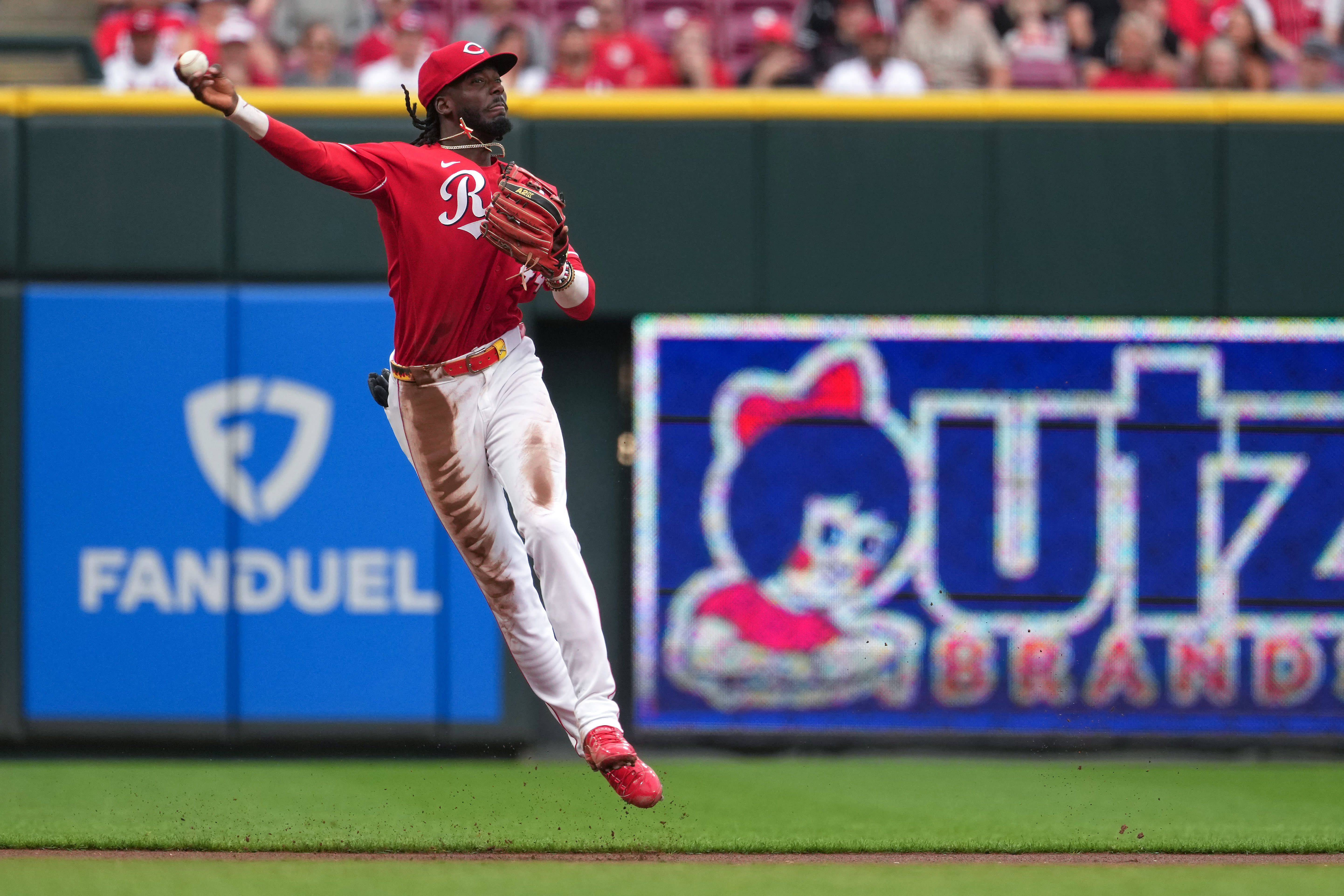
We’re a month into the season, and Elly De La Cruz is doing it all.
We already knew Elly had all the tools to be an all-around superstar. But it’s fun to watch him put it all together.
First of all, there’s the elite power-speed combo, which has him in rare company. De La Cruz has 10 home runs — tied with James Wood and Kyle Schwarber for the National League lead — and eight stolen bases through the Reds’ first 30 games.
Only seven players in the Modern Era have had at least 10 homers and eight steals in the first 30 games of a season.
10+ HR and 8+ SB in team’s first 30 games of a season
The last two players to do it before De La Cruz are Hall of Famers, and then you have Bonds. It’s also pretty cool to see Elly on a list with the Reds’ previous power-speed icon, Davis — whose 37-homer, 50-steal season in ’87 was the first 30-50 season in MLB history.
(Also … yes, that’s really Mo Vaughn on that list. That was the year Vaughn won MVP, and he had a career high in stolen bases. Now, that career high was only 11 steals, but Vaughn stacked up most of them at the beginning of the season. Strange but true.)
Then you throw in De La Cruz’s defense on top of that bat and those wheels. Elly led the Majors in errors in both 2024 and 2025, but he’s cut down on those significantly in 2026, and he’s making plays like this:

The Reds wouldn’t be in first place without De La Cruz. It’s no wonder his teammates are calling him “the best player in the world.”
Here are five big things happening around the Majors.
• Olson’s first walk-off in ATL
Would you believe Matt Olson had never hit a walk-off home run with the Braves until now? Well, it’s true. But the star slugger, who came to Atlanta in 2022, finally did it yesterday with a game-winning blast off Kenley Jansen to lift the MLB-best Braves past the Tigers (in a Tarik Skubal start, no less). It was the fourth walk-off homer of Olson’s career, but his first three all came with the A’s.
• PCA hitting his stride
Pete Crow-Armstrong homered in his second straight game for the Cubs yesterday after going homerless over his previous 18 games. Both of those blasts led Chicago to wins over the Padres. Crow-Armstrong has been playing his usual elite defense in center field all season, but with so many other hitters on the Cubs raking right now, PCA breaking out of his slump makes that lineup extremely dangerous.
• Druw Jones one-ups his dad
The junior Jones just did something his Hall of Famer father Andruw never did: The D-backs prospect hit for the cycle yesterday at Double-A. That rare feat showcased the 22-year-old’s offensive potential … and it’s just a cool thing to hit for the cycle. Druw, who was drafted No. 2 overall in 2022, is currently ranked Arizona’s No. 16 prospect by MLB Pipeline.
• Jays getting it going
The Blue Jays are starting to play like the reigning pennant winners they are. Toronto is 7-3 in its last 10 games and has won three straight series against the Angels, Guardians and Red Sox. Yesterday’s win over Boston was an encouraging game for a couple of key hitters in particular: George Springer, who returned from the injured list with a pinch-hit RBI single, and Kazuma Okamoto, who has three homers and 10 RBIs over his last 10 games and is looking good in the cleanup spot.
• Ildemaro’s streak reaches 26
Ildemaro Vargas’ hitting streak is rising to historic heights. It’s now at 26 games overall going back to last September, and Vargas has hit safely in 23 straight games to start the 2026 season — including another hit today against the Brewers. Vargas’ streak is the longest season-opening hit streak in two decades, since Edgar Renteria’s 23-game streak for the Braves in 2006. He has the longest active hitting streak in the Majors — no one else has one longer than 14 games — and he’s leading the MLB batting race.

There’s already a must-see highlight from today’s slate of day games: James Wood using every inch of his 6-foot-6 frame to rob Juan Soto of a home run.
The Nats star is known more for his own home run hitting, but this time Wood went way up and over the fence at Citi Field to take a homer away from the Mets slugger.

It’s been a huge season for home run robberies — just yesterday, Cardinals rookie left fielder Nathan Church took a walk-off home run away from the Pirates’ Nick Gonzales — and now you can add Wood’s to the ever-growing highlight reel.
Put your baseball brain to the test with Daily Walkoff, where you can find 30 brand-new trivia puzzles every day, one for each team. Play Daily Walkoff >>


© 2026 MLB Advanced Media, L.P. MLB trademarks and copyrights are used with permission of Major League Baseball. Visit MLB.com. Any other marks used herein are trademarks of their respective owners.
Please review our Privacy Policy.
You (pahovis@aol.com) received this message because you registered to receive commercial email messages from MLB.com.
Please add info@marketing.mlbemail.com to your address book to ensure our messages reach your inbox. If you no longer wish to receive commercial email messages from MLB.com, please unsubscribe or log in and manage your email subscriptions.
Postal Address: MLB.com, c/o MLB Advanced Media, L.P., 1271 Avenue of the Americas, New York, NY 10020.
RJ Hamster

THE SIGNAL BY TRADEALGO
In 2024, members of Congress averaged 31% returns on their stock portfolios. The S&P 500 returned 24.9%. (Source: Fortune, Jan 2025 · STOCK Act filings)
That is not luck. It is information asymmetry.
Members of Congress sit on committees that regulate industries. They receive classified briefings. They meet with CEOs before major announcements. And thanks to the STOCK Act of 2012, they are required to disclose their trades within 45 days.
45 days is a long time. But it is still a window into what the most informed traders in America are buying.
CONGRESSIONAL TRADING VS S&P 500 (2024)
31%
Avg. Congress Return
24.9%
S&P 500 Return
Source: Unusual Whales Congressional Trading Report, 2024
TOP PERFORMING MEMBERS (2024 YTD VS S&P 24.9%)
Rep. Nancy Pelosi (D-CA)
Former Speaker of the House+65%
+40% vs S&P
Rep. Dan Crenshaw (R-TX)
Armed Services Committee+31%
+6% vs S&P
Rep. Michael McCaul (R-TX)
Foreign Affairs Chair+26%
+1% vs S&P
Sen. Tommy Tuberville (R-AL)
Armed Services Committee+24%
-1% vs S&P
Source: STOCK Act filings via Unusual Whales 2024 Annual Report · as reported by Fortune
HOW WE TRACK CONGRESSIONAL TRADES
✓Real-time STOCK Act filings
Scraped daily from House and Senate
✓Committee correlation
Match trades to member oversight areas
✓Cluster detection
Multiple members buying the same stock
✓Size weighting
Larger purchases get more attention
REAL EXAMPLE: PELOSI NVDA BUY (Source: STOCK Act Filing, Nov 2023)
NVDACONGRESS
$450 → $875
Nov 2023 to Mar 2024 (4 months)+94%
stock gain
WHY THE AI FLAGGED IT
Nancy Pelosi disclosed a $1M+ NVDA call option purchase in November 2023. Our AI flagged the filing within 24 hours of disclosure. Four months later, the position was up 94%.
WHAT HAPPENS WHEN AI TRACKS CONGRESS FOR YOU+70%
+50%
+30%
+10%
0%
Everest Growth+71%
Core Growth+66%
S&P 500+17%JanAprJulOctNow Everest Growth
+71% Core Growth
+66% S&P 500
+17%
Congressional trades are one of the four data sources powering these portfolios. Our AI monitors filings in real time, finds the patterns, and acts automatically.
Past performance does not guarantee future results
LIVE WEBINAR
How AI Is Replacing Congress’s Edge
Sunday, May 4th · 7:00 PM ET
90 minutes · Replay included→ Reserve My Seat
Only 500 live spots
Join hundreds of members who have already registered
Congressional trades are just one of the four data sources our AI monitors. Dark pools. Options flow. Insider filings. All feeding into one system.
On May 4th, we are showing you exactly how it works. How AI is changing the game. And how you can put it to work for you.
Spots are limited. Register now.
The Signal Team
TradeAlgo · New York★★★★★ 4.7/5 on Trustpilot
Past performance is not indicative of future results. Trading involves substantial risk. This is educational content, not investment advice.
TradeAlgo Inc. · 224 West 30th Street, New York, NY 10001
Unsubscribe | Manage Preferences