When historians assess Joe Biden’s tenure in the Oval Office, it is likely they will point to the week that began on Sunday, Sept. 10, as having six of the most challenging days of his presidency, culminating in the federal indictment of first son Hunter Biden on three gun-related felony charges.
Consider the events of each of those six days:
Sunday—President Biden woke up to this headline in David Ignatius’s column in the Washington Post: “President Biden Should Not Run Again in 2024.” Mr. Ignatius is one of the president’s favorite journalists, one of the few he has consistently read throughout his five decades as a senator, vice president, and the nation’s chief executive.
Mr. Ignatius, who is tightly sourced in the intelligence community and is a leading influencer of Democratic progressive thought, cited a survey that found 69 percent of Democrats think President Biden, 80, is too old to be president for a second term. The column said plainly what many prominent Democrats have kept to themselves.
“Right now, there’s no clear alternative to Biden—no screamingly obvious replacement waiting in the wings. That might be the decider for Biden, that there’s seemingly nobody else. But maybe he will trust in democracy to discover new leadership, ‘in the arena,'” Mr. Ignatius writes.
Monday–On the 22nd anniversary of the 9/11 attacks that killed nearly 3,000 Americans in 2001, President Biden became the first president not to commemorate those losses by attending memorial services at the World Trade Center in New York, the Pentagon in Washington, the crash site of Flight 93 in Pennsylvania, or at the White House.
On the last leg of his return journey from Vietnam, the president instead chose to deliver remarks at a U.S. military base near Anchorage, Alaska, while Vice President Kamala Harris attended the 9/11 ceremony in New York. The Vietnam stop had been scheduled in advance of the 9/11 memorials, the administration said.
(Spencer Platt/Getty Images)
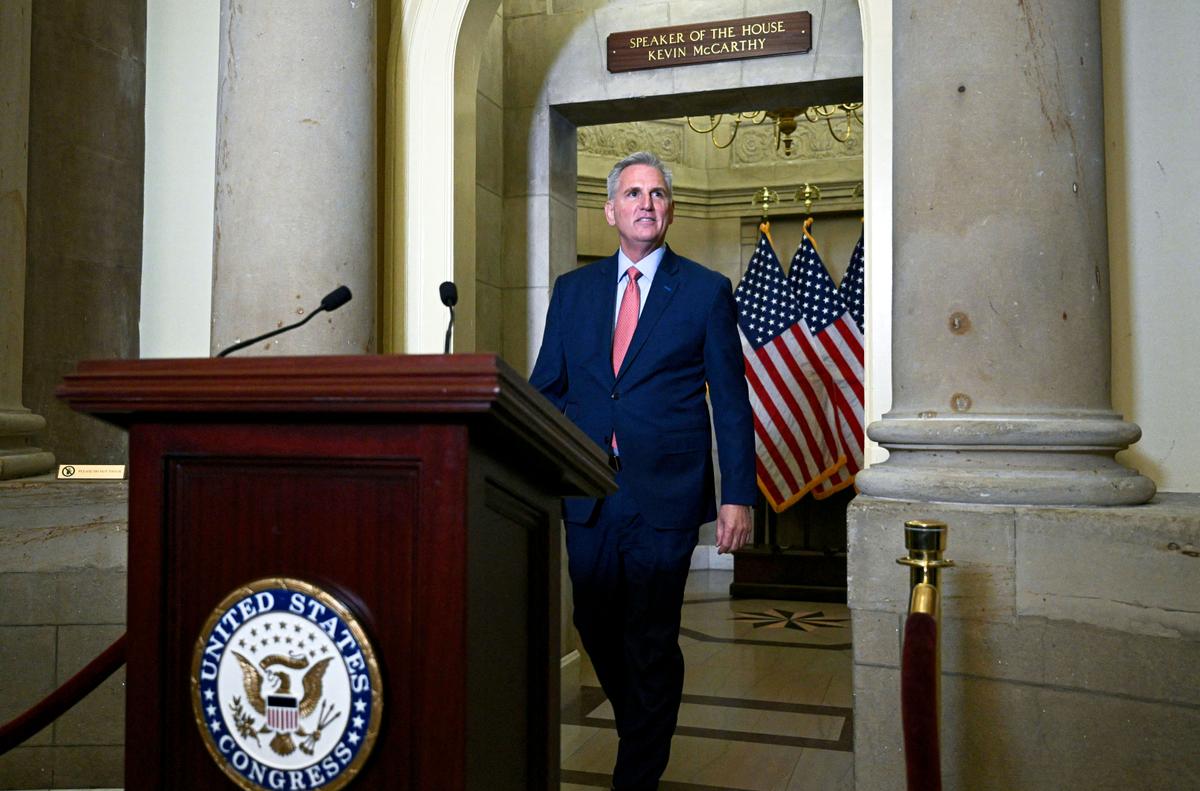
Tuesday–Speaker of the House Kevin McCarthy (R-Calif.) announced the chairmen of three committees that have been investigating allegations of influence-peddling by President Biden and his son Hunter will proceed to a formal impeachment inquiry.
That move is expected to make it much more difficult for the Biden administration to withhold documents and witnesses sought for months by the three chairmen.
Wednesday–As President Biden was preparing to address a reelection campaign rally in Maryland the next day, the latest Consumer Price Index report showed inflation increased in August to an annual rate of 3.7 percent, up from 3.2 percent in July. The continuing inflation challenges the president’s attempts to sell “Bidenomics” as the key to restoring economic prosperity.
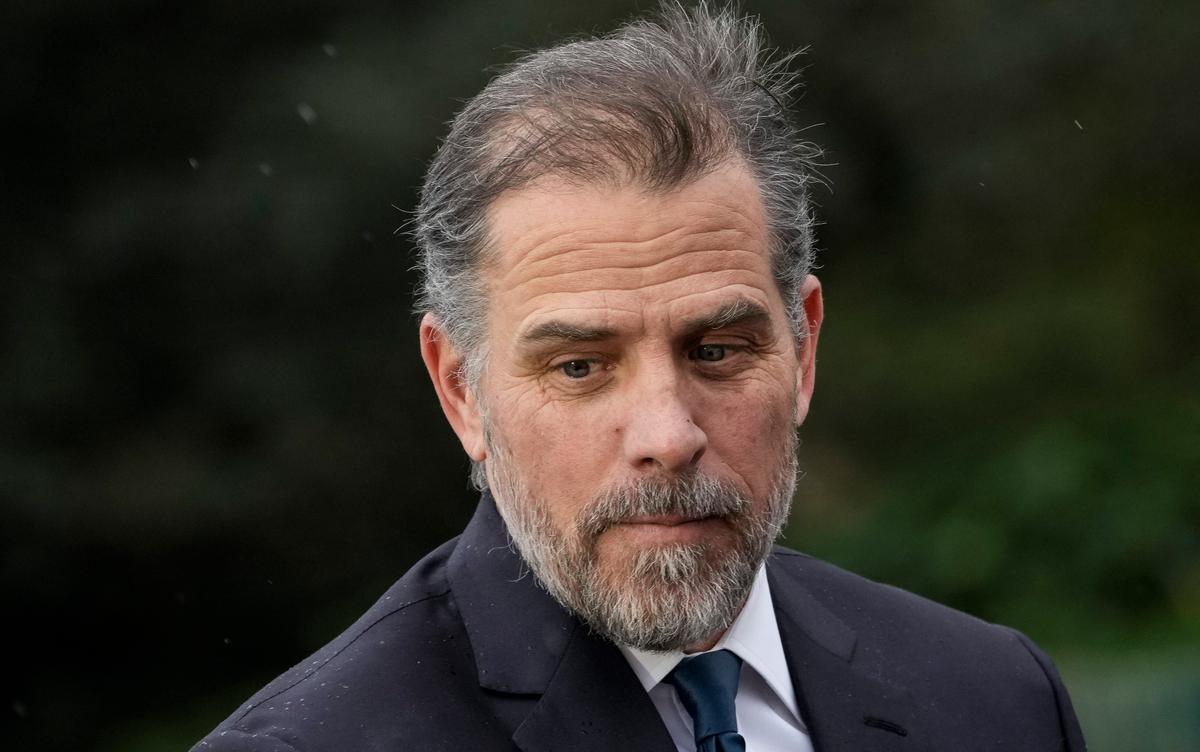
Thursday–Special Counsel David Weiss announced three felony gun charges against Hunter Biden, weeks after a plea agreement with the Justice Department fell apart.
Friday–Members of the United Auto Workers (UAW) walked out of selected automotive assembly plants of General Motors, Ford, and Stellantis (formerly Chrysler), marking the first time the storied union struck each of the “Big Three” at the same time.
The union is demanding a 46 percent pay raise, a shorter workweek, and other new benefits, making a speedy settlement difficult to achieve. There are nearly 10 million automotive-related jobs in the economy, and every such position helps support an estimated 10.5 millions positions in other industries. An extended strike will inflict damage throughout the U.S. economy.
(Matthew Hatcher/AFP via Getty Images)
Mr. Tarrio and his cohorts were not allowed to probe very deeply or learn much about what could have been dozens of federal informants embedded in the Proud Boys on Jan. 6. One defense attorney said there were more than 50 “confidential human sources” spying on the group.
Much like the prosecution of nearly two dozen members of the Oath Keepers, the Proud Boys’ nearly four-month trial tilled potentially fertile ground for precedent-setting action by the U.S. Court of Appeals and the U.S. Supreme Court.
The backbone of the prosecution of the Proud Boys and Oath Keepers is the Civil War-era seditious conspiracy law.
Section 18 U.S. Code §2384 states that seditious conspiracy exists when two or more people “conspire to overthrow, put down, or to destroy by force the government of the United States, or to levy war against them, or to oppose by force the authority thereof, or by force to prevent, hinder, or delay the execution of any law of the United States, or by force to seize, take, or possess any property of the United States…”
The federal statute might well be used against former President Trump in a superseding indictment to charges brought against him by DOJ Special Prosecutor Jack Smith.
Defending against seditious conspiracy in a D.C. federal court looks a bit like trying to nail Jell-O to the wall. Such a charge could pose a danger to President Trump in the overwhelmingly Democratic District of Columbia.
Another prominent felony charge used against the Proud Boys and Oath Keepers is obstruction of an official proceeding. The federal statute has never been employed in such a manner, and the controversy surrounding it has pushed one Jan. 6 case to the U.S. Supreme Court.
Mark Tapscott
To dig deeper into the subject, read the following original reporting by our journalists:
Thank you for being a subscriber If you enjoy what you’re reading, please consider forwarding this email to someone who might find it informative. Your Feedback What do you think of our pick for the top story this week?
We’d love to hear from you. You can email me at topstory@epochtimes.nyc.
We may feature an exerpt of your response in the next newsletter.
 RJ Hamster